
Specifying software requirements can be a repetitive and time-consuming task. In requirements engineering, requirement patterns have been proposed as a way to make this process easier by encouraging reuse. Instead of writing similar requirements from scratch every time, teams can rely on reusable structures that capture common needs.
However, most existing approaches focus mainly on reusing patterns in textual requirement documents. This leaves an important gap: many modern software development processes rely not only on text, but also on software models. At the same time, approaches that reuse models as requirement patterns are often tied to specific modelling languages, which limits their use across different tools and environments.
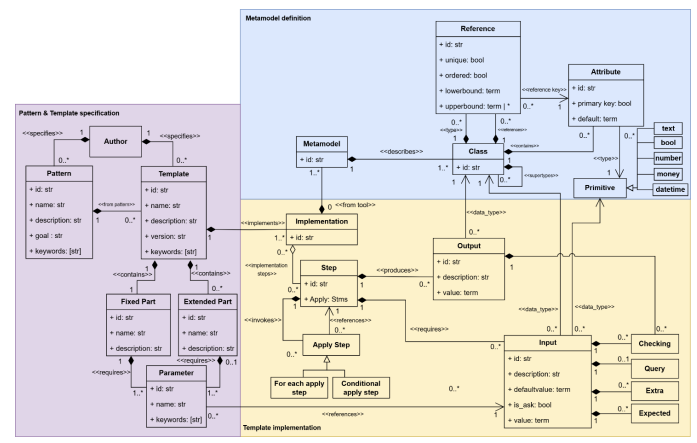
To address this challenge, we introduce LEMON, a domain-specific language designed to specify and reuse requirement patterns in model-driven software development tools.
LEMON makes it possible to define reusable requirement patterns and templates that can be adapted and integrated into different modelling environments. Instead of being limited to one specific modelling language, LEMON is designed to work with the metamodels of different MDSD tools, supporting greater flexibility and customization.
In our work, we present the formal structure of the LEMON language using Extended Backus-Naur Form (EBNF) and illustrate its use through an industry-inspired example. We also describe the implementation of an execution environment showing how LEMON can be integrated into an MDSD tool.
With LEMON, our goal is to make requirements specification in model-driven development more systematic, reusable, and tool-independent. This is an important step toward helping software teams reduce repetitive work, improve consistency, and better connect requirements engineering with model-driven software development practices.
Looking ahead, we aim to continue evolving LEMON and exploring how requirement patterns can better support the development of software systems across different domains and modelling environments.
Leave a Reply